
Blogs
- Home
- Blog details
Wheel vs Continuous Chocolate Tempering Machine: Which Should You Choose?
- By : Deepak
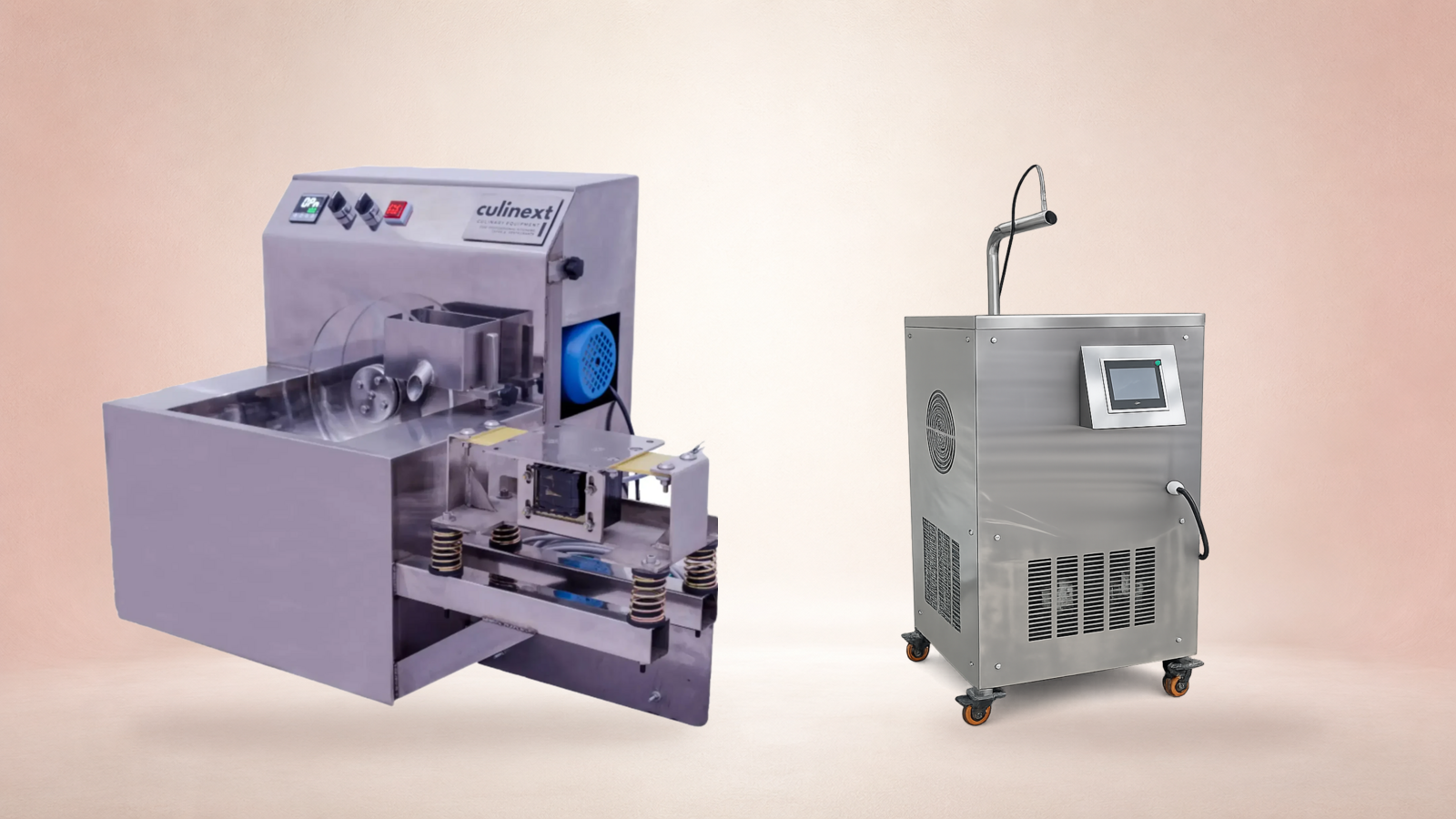
Short answer: choose a wheel machine when you need an accessible batch-oriented system for melting, holding, circulating and working chocolate. Choose a continuous tempering machine when you need controlled heating, cooling and continuous delivery of tempered couverture at a repeatable production rate. The right choice depends first on chocolate type, then on output and workflow.
The two machines may appear to perform a similar job, but their process capability and production role are different. Comparing only bowl capacity or purchase price can therefore lead to the wrong investment.
Why does chocolate type come first?
Couverture chocolate contains cocoa butter and normally needs controlled pre-crystallisation when the final product requires gloss, clean snap, contraction from moulds and stable handling. Tempering manages that crystal structure through a controlled temperature process.
Compound chocolate uses alternative vegetable fat systems and usually does not require traditional cocoa-butter tempering. It generally needs controlled melting, holding and handling according to the supplier’s recommended temperature range.
That means a machine described commercially as a “tempering machine” may play a different role for compound chocolate than it does for couverture. Confirm the chocolate formulation and required process before comparing models.
How does a wheel tempering machine work?
A wheel machine uses a heated bowl or tank and a rotating wheel to circulate chocolate. The wheel lifts and moves chocolate continuously, making it accessible for mould filling, coating, dipping or connection to suitable accessories.
Depending on the configuration, a wheel machine may include:
- temperature control;
- a heated chocolate reservoir;
- a rotating circulation wheel;
- a vibrating table or vibrator;
- a swinging arm for distribution;
- an active cooling system on higher configurations.
A wheel machine without controlled cooling should not be assumed to perform the same automatic tempering cycle as a continuous temperer. Its exact role depends on the model and chocolate being processed.
How does a continuous tempering machine work?
A continuous tempering machine combines controlled heating, circulation and cooling. Chocolate moves through the system while the machine manages the process conditions required to deliver a continuous supply for moulding or downstream equipment.
This type of system is designed to reduce repeated manual batch tempering and support a more consistent production flow. It is particularly relevant when the next operation—such as moulding, enrobing or depositing—requires tempered chocolate continuously.
The Culinext Continuous Chocolate Tempering Machine is specified for couverture chocolate and is available in 4 kg and 12 kg models. The 4 kg model has a stated output of approximately 10 kg/hour; the 12 kg model is rated at approximately 30–45 kg/hour, subject to the confirmed operating conditions and product.
Wheel vs continuous tempering machine: direct comparison
| Decision factor | Wheel machine | Continuous tempering machine |
|---|---|---|
| Primary workflow | Batch-oriented melting, holding, circulation and chocolate handling | Controlled tempering with continuous chocolate delivery |
| Chocolate type | Depends on configuration; confirm compound or couverture compatibility | Typically selected for couverture; confirm the exact formulation |
| Cooling | May be absent or available only on a higher model | Integrated controlled cooling is central to the process |
| Output style | Operator-led batch use from the bowl or wheel | Repeatable continuous supply for longer production runs |
| Automation | Simpler controls; options vary by model | Higher process control, often with PLC/HMI operation |
| Integration | Useful for manual moulding, dipping and suitable accessories | Better suited to connected moulding, enrobing or cooling workflows |
| Investment | Generally the more accessible entry route | Higher investment for automation and continuous output |
| Best fit | Cafés, bakeries, confectioners and batch producers | Growing chocolatiers and production lines using couverture |
When should you choose a wheel machine?
A wheel machine may be the better choice when:
- production is organised around manageable batches;
- operators need easy access to chocolate for manual moulding or coating;
- the business primarily handles compound chocolate;
- the budget does not yet justify a continuous system;
- a vibrator or swinging arm would improve the existing workflow;
- the product range changes frequently and continuous output is unnecessary.
The Culinext 15 kg Chocolate Wheel Tempering Machine is offered in Basic, Plus, Deluxe, Pro and Premium configurations. Basic, Plus, Deluxe and Pro are specified for compound chocolate. The Premium model adds a cooling unit and supports both couverture and compound chocolate.
This configuration difference is critical. Do not purchase a non-cooling model for couverture on the assumption that heating and circulation alone will provide a complete automatic tempering cycle.
When should you choose a continuous tempering machine?
A continuous system may be the better investment when:
- couverture chocolate is central to the product range;
- batch tempering has become a production bottleneck;
- the team needs repeatable chocolate flow over longer runs;
- moulding, enrobing or depositing requires a steady supply;
- labour is being consumed by repeated manual tempering;
- the business can use the machine’s rated output consistently;
- future production-line integration is planned.
Culinext’s continuous models use touchscreen PLC/HMI control, PID-managed temperature control, SS304 construction and a closed-loop cooling system. The appropriate model should be selected from required hourly output, product behaviour, downstream equipment and available utilities.
Capacity and output are not the same measurement
A wheel machine is commonly discussed by the amount held in its bowl. A continuous machine may be discussed by both bowl capacity and kilograms delivered per hour. Those numbers are not interchangeable.
For example, Culinext’s continuous range includes:
- 4 kg model: 4 L bowl, approximately 10 kg/hour stated output;
- 12 kg model: 12 L bowl, approximately 30–45 kg/hour stated output.
Output depends on the confirmed operating conditions, chocolate formulation and workflow. Ask how the rating is measured and whether your downstream operation can consume chocolate at that rate. Buying output that the moulding or cooling stage cannot use simply moves the bottleneck.
Seven questions to answer before requesting a quote
1. Are you using couverture or compound?
This determines whether true cocoa-butter tempering is required and immediately narrows the correct machine configurations.
2. How many kilograms must be processed per hour?
Use current orders and realistic growth, not an optimistic sales target. Include peak seasonal requirements separately.
3. What happens immediately after tempering?
Manual mould filling, a depositor, an enrober and a cooling tunnel demand different chocolate-flow arrangements.
4. How often does the product change?
Frequent changes between dark, milk, white, flavoured or allergen-containing recipes affect cleaning and scheduling.
5. What utilities are available?
Confirm voltage, phase, connected electrical load, ambient conditions and any cooling or ventilation requirements before finalising the model.
6. How much operator involvement is acceptable?
A simpler batch machine may suit a hands-on artisan workflow. A continuous machine makes more sense when repeatability and reduced manual handling justify the additional investment.
7. What is the real budget?
Include installation, electrical preparation, accessories, moulding equipment, cooling, training, maintenance and working capital—not only the machine price.
Common buying mistakes
- Buying by machine name alone: “Tempering machine” can describe systems with very different capabilities.
- Ignoring chocolate formulation: compound and couverture do not require the same process.
- Comparing bowl capacity with hourly output: they measure different things.
- Assuming every wheel model includes cooling: cooling may be configuration-specific.
- Automating one isolated step: the moulding and cooling stages must keep pace.
- Skipping real-machine demonstrations: videos and trials reveal access, flow and operator requirements that a brochure cannot.
Before deciding, explore the Culinext chocolate machinery video library to see actual machines and chocolate movement.
Frequently asked questions
Is a wheel tempering machine fully automatic?
Not necessarily. Wheel machines vary by configuration. Some primarily melt, hold and circulate chocolate; higher models may add cooling and other accessories. Confirm the exact process capability rather than relying on the category name.
Can compound chocolate be used in a continuous tempering machine?
Compound chocolate normally does not need traditional cocoa-butter tempering. Culinext’s current continuous machine application is confirmed for couverture chocolate. Discuss the exact compound formulation and required handling process before considering any machine.
Which machine is better for a small chocolatier?
A wheel machine may be the more practical entry point for batch production and manual work. A small continuous temperer may be justified when the chocolatier uses couverture, needs repeatable output and has enough downstream demand to use it.
Does a continuous machine eliminate every tempering problem?
No. Correct formulation, loading, temperature settings, maintenance, ambient control and operator procedure still matter. Automation improves process control; it does not make unsuitable chocolate or poor handling irrelevant.
Can a continuous tempering machine connect to other equipment?
Yes, suitable systems can be integrated with equipment such as enrobers and cooling tunnels. The chocolate-flow rate, height, interface and control requirements should be planned as one line.
Choose the production system, not merely the machine
A wheel machine and a continuous temperer are not simply small and large versions of the same equipment. One supports an accessible batch-oriented workflow; the other is built around controlled tempering and continuous output.
Not sure which route fits your chocolate? Send Culinext your chocolate type, required output and downstream process. The engineering team can compare wheel configurations with the 4 kg and 12 kg continuous systems before you invest.
Related Posts
Popular Tags
Related Posts
✕