
Blogs
- Home
- Blog details
What Machines Do You Need to Start a Chocolate Business in India?
- By : Deepak
Short answer: the machines required to start a chocolate business depend on what you will actually sell. A business using purchased compound or couverture needs a very different setup from a bean-to-bar factory processing cocoa beans. Define the product route first, calculate realistic output second, and purchase only the equipment needed for that route.
This approach protects working capital. Many new businesses overspend on impressive machines before proving demand, while others buy household equipment that cannot support repeatable commercial production. A good startup line is neither the cheapest possible collection nor a miniature industrial factory—it is a balanced workflow without one obvious bottleneck.
First choose your chocolate-business model
Most small chocolate businesses fall into one of three production paths.
Path 1: compound-chocolate confectionery
This route uses ready-made compound chocolate for moulded products, decorations, bakery applications, dipping or coating. Compound systems generally require controlled melting and holding rather than traditional cocoa-butter tempering.
This is often the simplest machinery route, but product quality still depends on clean handling, correct working temperature, mould preparation, vibration, cooling and packaging.
Path 2: couverture-based chocolates
This route uses purchased couverture to make bars, pralines, bonbons, shells, coatings and premium moulded products. Couverture normally requires controlled tempering when gloss, snap, contraction and stable handling are needed.
The core line therefore centres on reliable melting and tempering, followed by moulding or depositing, vibration and controlled cooling.
Path 3: bean-to-bar chocolate
This route starts with cocoa beans and includes more process stages: sorting, roasting, cracking and winnowing, grinding or refining, recipe development, tempering, moulding, cooling and packaging.
Bean-to-bar offers greater control over origin and recipe, but it also requires more equipment, process knowledge, floor space, quality control and working capital.
Equipment map for each startup route
| Process stage | Compound route | Couverture route | Bean-to-bar route |
|---|---|---|---|
| Raw-material preparation | Ready-made compound | Ready-made couverture | Bean sorting and roasting |
| Cracking and shell separation | Not required | Not required | Cracker and winnower |
| Refining | Not normally required | Not normally required | Melanger or another suitable refiner |
| Melting and holding | Melter or wheel system | Melter and/or tempering system | Planned around the refining and tempering workflow |
| Tempering | Traditional tempering generally not required | Required for suitable finished applications | Required for suitable cocoa-butter chocolate applications |
| Portioning | Manual filling or depositor | Manual filling or depositor | Manual filling or depositor |
| Bubble removal and mould settling | Vibrating table | Vibrating table | Vibrating table |
| Cooling and setting | Controlled cooling appropriate to the product | Controlled cooling appropriate to the product | Controlled cooling appropriate to the product |
| Finishing | Demoulding and packaging | Demoulding and packaging | Demoulding and packaging |
Essential machines for a compound-chocolate business
1. Chocolate melter or holding system
A melter heats chocolate gradually and holds it at a controlled working temperature. Choose capacity from the amount used during a normal production session, not the total sales target for the month.
If the workflow needs continuous operator access, a wheel system can circulate chocolate for moulding, dipping or coating. Confirm that the selected model is specified for compound chocolate.
2. Moulds and manual portioning tools
At startup scale, accurate manual filling may be more sensible than buying a depositor immediately. Use durable food-contact moulds that match the intended bar or confectionery design. Standardising a small number of mould formats can simplify packaging and production planning.
3. Chocolate vibrating table
A chocolate vibrating table helps settle chocolate in mould cavities and release trapped air after filling. It can improve surface finish and reduce avoidable defects without requiring a fully automated line.
4. Controlled cooling and storage
Cooling must suit the product, mould and local environment. In Indian conditions, ambient heat and humidity can become production variables rather than background details. Plan clean cooling capacity and finished-goods storage before increasing melting capacity.
Essential machines for a couverture-based chocolatier
1. Melting and tempering equipment
Couverture must be melted and pre-crystallised correctly for applications that need a glossy finish, firm snap and reliable mould release. The equipment choice usually begins with either a suitable cooling-equipped wheel model or a continuous tempering machine.
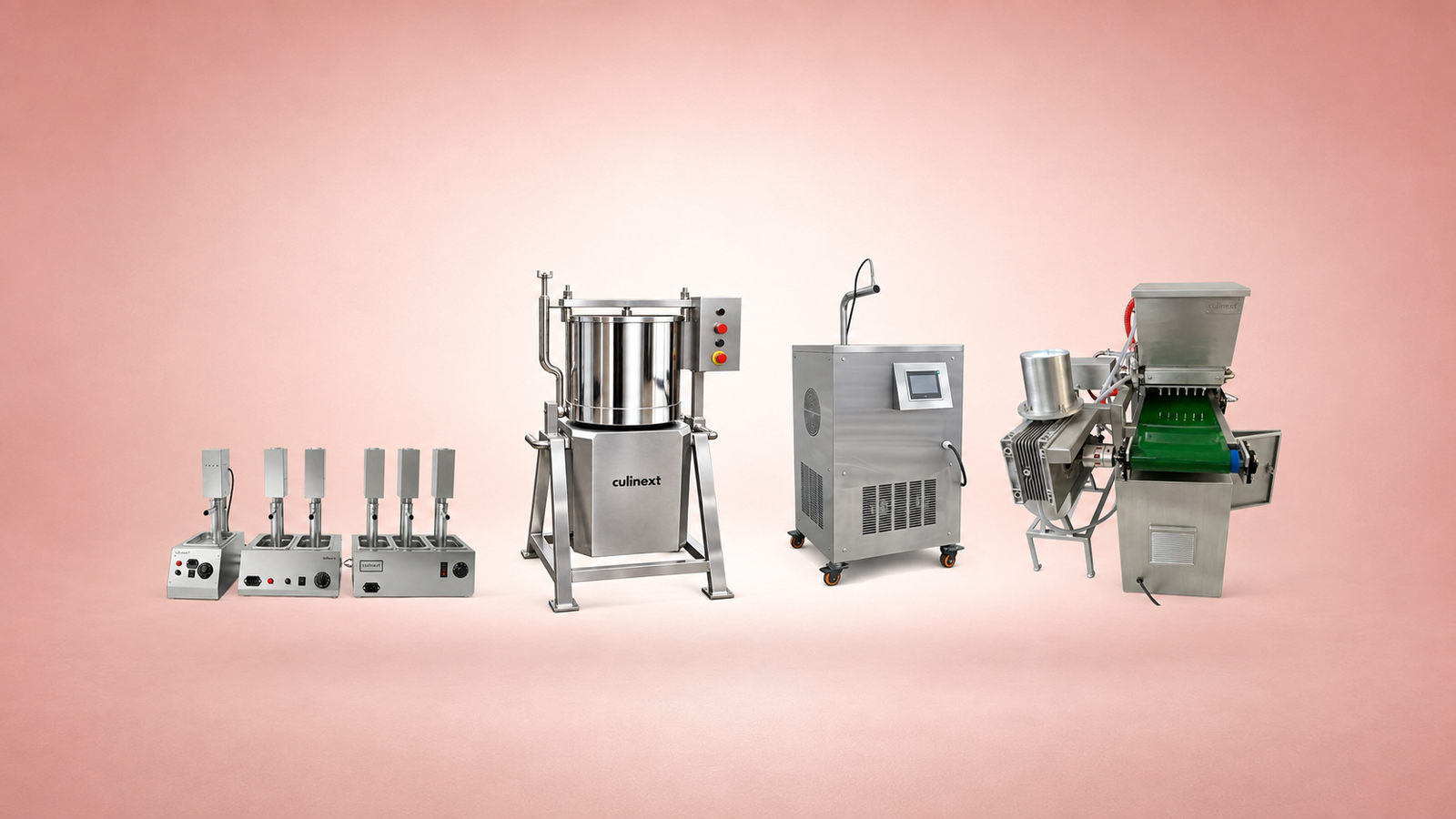
The Culinext 15 kg Wheel Tempering Machine is available in multiple configurations; its Premium model supports couverture and compound chocolate. The Culinext Continuous Chocolate Tempering Machine is specified for couverture and is available in 4 kg and 12 kg models.
2. Moulding, vibration and cooling
The temperer cannot compensate for a downstream bottleneck. Plan how quickly operators can fill moulds, vibrate them, move them into cooling and demould the finished pieces. A machine that supplies chocolate faster than the rest of the line can handle will not deliver its theoretical productivity.
3. Depositor when volume justifies it
A depositor improves portion consistency and reduces repetitive manual filling when order volume becomes predictable. It should be selected from deposit weight, mould dimensions, nozzle arrangement, product viscosity and required output.
Culinext’s servo-controlled Chocolate Depositor is available in semi-automatic and fully automatic configurations for businesses that have moved beyond manual filling.
Essential machines for a bean-to-bar startup
1. Cocoa-bean sorting and roasting equipment
Bean quality and roast profile influence flavour before refining begins. Plan a repeatable method for inspection, sorting, roasting and cooling beans. Roaster capacity should align with downstream batch size rather than becoming an isolated number.
2. Cocoa bean cracker and winnower
After roasting, beans are cracked and lighter shell material is separated from the nibs. The Culinext Cocoa Bean Cracker & Winnower combines adjustable cracking with suction-controlled shell separation and has a stated processing capacity of 50 kg/hour.
Upstream and downstream capacities do not need to match hourly on paper if the process runs in planned campaigns, but storage and scheduling between stages must be intentional.
3. Chocolate melanger or refiner
A melanger uses stone grinding to reduce particle size and develop chocolate texture over an extended cycle. This is frequently the longest stage in a small bean-to-bar workflow, so it can determine weekly output even when the cracker and winnower processes material much faster.
The Culinext Premium Chocolate Melanger is available in 5 kg, 10 kg, 20 kg, 30 kg, 50 kg, 70 kg and 100 kg capacities. Select from complete cycle time and required weekly output, not from batch capacity alone.
4. Tempering system
After refining and recipe development, finished cocoa-butter chocolate generally needs controlled tempering for bars and moulded products. Choose between manual, wheel-based and continuous approaches based on product volume and labour—not because one machine looks more advanced.
5. Moulding, vibration, cooling and packaging
The final stages determine appearance, weight consistency and protection during distribution. Plan mould handling, vibration, cooling, demoulding, wrapping, labelling and finished storage as part of the production line.
See the Culinext bean-to-bar process overview for a stage-by-stage view of the machinery flow.
How to calculate machine capacity
Build a simple capacity sheet before requesting quotations:
- List each product and its weekly sales target.
- Convert units sold into kilograms of chocolate.
- Add samples, breakage, transfer loss and sensible demand headroom.
- Map every process stage and its cycle time.
- Record cleaning and recipe-change time.
- Identify the slowest stage.
- Select equipment that keeps the line balanced around that constraint.
For example, purchasing a high-output temperer does not solve production if one operator can fill only a fraction of that output into moulds. Likewise, a 50 kg/hour cracker and winnower does not mean a small melanger must process 50 kg every hour; nibs may be prepared in a scheduled campaign and refined in later batches.
Plan utilities and floor space before placing orders
For every machine, confirm:
- voltage and phase;
- connected electrical load and protection;
- machine dimensions and operating clearance;
- ventilation and ambient-temperature requirements;
- water or drainage needs, if applicable;
- material movement and operator access;
- cleaning method and hygienic separation;
- finished-product cooling and storage;
- space for future equipment without blocking today’s workflow.
Ask for a simple layout before buying multiple machines. Correct sequence and movement can save more labour than an isolated automation feature.
What should a low-budget startup buy first?
Buy the minimum system that can produce the first saleable product reliably and hygienically. Preserve cash for ingredients, packaging, product development, marketing, utilities and operating months.
A sensible staged approach is:
- Prove the product: start with a narrow product range and controlled small batches.
- Remove the first bottleneck: invest where manual work causes inconsistent quality or missed orders.
- Standardise: document recipes, temperatures, cycle times, cleaning and yield.
- Add capacity: choose the next machine from actual production records.
- Automate repetitive flow: consider continuous tempering or depositing after demand justifies it.
Do not build a bean-to-bar factory if the immediate business model is moulding purchased couverture. Do not buy a depositor before the product range and mould format are stable. And do not spend the complete budget on stainless steel while leaving nothing for working capital.
Questions to ask every machinery supplier
- Is the stated capacity a batch capacity or hourly output?
- For which chocolate formulation and conditions was output measured?
- What voltage, phase and connected load are required?
- Which food-contact materials are used?
- What installation, training and operating documentation are provided?
- What is covered by the warranty?
- Which consumables or wear parts require replacement?
- Can I see the actual model operating with chocolate?
- How does it connect to the next production stage?
- What information do you need to confirm suitability for my recipe?
Culinext maintains a video library of real chocolate machinery demonstrations, which can help buyers review working arrangements before discussing a quotation.
Frequently asked questions
How much machinery is needed for a home-based chocolate business?
A home-based business using purchased chocolate may begin with controlled melting, accurate temperature measurement, suitable moulds, vibration, cooling and hygienic packaging. Commercial electrical load, food-production suitability and local compliance must be evaluated before installing professional machinery in a residence.
Do I need a melanger to make chocolates?
Only if you are refining ingredients into chocolate or making another suitable stone-ground product. A business that buys finished compound or couverture normally does not need a melanger for moulding that chocolate.
Do I need a tempering machine?
Couverture used for bars, shells or coatings normally needs tempering. Compound chocolate generally does not require traditional cocoa-butter tempering, although it still needs controlled melting and handling.
Which machine should a bean-to-bar startup buy first?
The answer depends on whether roasting and winnowing will be done in-house. For a complete in-house process, plan the entire flow before purchasing any single machine. The melanger often becomes the scheduling constraint because refining takes much longer than cracking and winnowing.
Can I add automation later?
Yes, if the initial layout, electrical supply and material flow leave room for it. A staged line can begin with manual mould filling and later add a depositor, higher-output tempering or connected cooling equipment.
Does buying a larger machine always reduce production cost?
No. A larger machine helps only when demand, labour, utilities and downstream capacity can use it. Under-loaded equipment, excess cleaning effort and idle capital can increase the effective cost per kilogram.
Build the smallest complete workflow that can grow
The right startup equipment list begins with the finished product. Compound confectionery, couverture work and bean-to-bar production each require a different line. Once that decision is clear, capacity, utilities, floor layout and automation can be planned without wasting scarce capital.
Planning a chocolate-production setup in India? Send Culinext your intended products, kilograms per day, chocolate type, available space and electrical supply. The engineering team can map a practical first-stage line and identify which machines can wait until demand grows.
Related Posts

Popular Tags
Related Posts
✕